
I was 13 when I lost my innocence at the hands of a boy named Larry. But, it’s not what you think: we didn’t have sex. In fact, I don’t think we ever actually spoke to one another. To be truthful, my innocence had by then been slipping away. I mean, by then, I had dim childhood memories of the assassinations of Martin Luther King Jr.and Robert Kennedy. I was also keenly aware of the still-unfolding debacle in Vietnam, since my dad had served there. And, because we were living in the Washington, D.C. area, I had a front row seat to the mushrooming Watergate investigation. Still, though, I can distinctly remember the day that my understanding of how things work changed. In one afternoon, I saw how painful and puzzling the world can be–especially for a girl.
Two years earlier, my family had moved to the ever-expanding edge of a Northern Virginia suburb blandly named Dale City–apparently in a nod to the area’s “hills and dales.” I was in sixth grade, and I went to the one middle school set up for the entire development. By eighth grade, Dale City had grown so much that the school district had to build another facility. I was transferred into it.

At the old school, I had been on the margins of a group of mostly smart but too-cool-for-school girls. A few of them had already had sex and would brag giddily about their occasional pregnancy scares in gym class. They were 12. My emotional immaturity was obvious to anyone looking. I mean, I still kept my dolls on my bed. But, I was fun, very loyal, and had gotten close to a couple of the smarter and more studious among them. They tolerated me. Even though I made nice-enough friends at the new school, and my grades improved, something was changing inside that was making me restless and unhappy. Had you asked me what was different, I could not have told you; but looking back, I would describe it as a sort of searching confusion about the point of it all. I would even sneak out of the house late at night to meet friends and just wander around the neighborhood. It was as if there was something important or authentic or liberating to be discovered lying just beyond our normal day-to-day lives, and I desperately wanted to find it.
Because all Dale City schools divided students into four color-coded groups, all on a staggered six-weeks-on/three-weeks-off schedule, the groups inevitably got mixed up at the new school. Since I had been in the red group and was starting eighth grade at the new school in the orange group, I didn’t know many of my classmates. One of them was a cute boy named Larry. He had long, reddish-brown, sort of curly hair and, though he wasn’t tall, he was lean and lanky. He reminded me of Peter Frampton. But, more than cute, he was mysterious because he hardly ever talked or smiled, and he dressed cool. I was smitten by him and, in my un-coolness, I had made it obvious to him. And even though I was pretty sure he was aware of my interest, he never spoke to me or, really, ever looked at me.
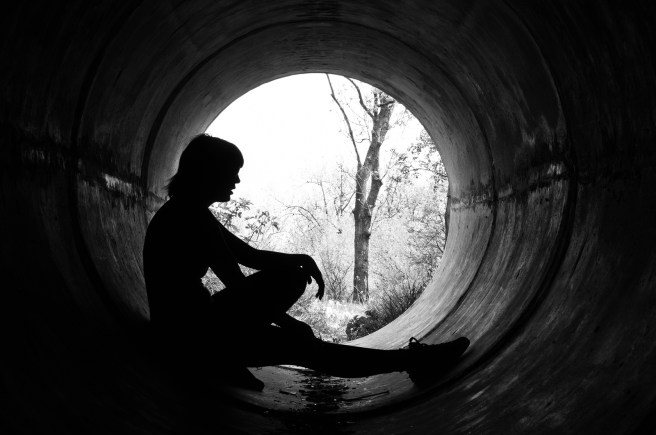
One Saturday afternoon, a friend of mine and I ventured aimlessly into a part of the suburb that was still under construction. It was far enough away from where anyone lived that it was very empty and quiet–a deserted, lawn-less landscape, pulsing with an eerie but somehow comforting feeling of desolation. Walking amid the unfinished houses gave us the sense that, though we hadn’t gone very far at all, we had escaped our regular lives. At one point, we came upon a row of giant empty sewer pipes, laid out side to side on the bare, bulldozed ground of a wide trench. Drawn to them the way littler kids are drawn to playground equipment, my friend and I stepped gingerly into and around these monstrous concrete tubes, entertained by the mere sight of something so oversized and out of place. All of a sudden, still enchanted by their novelty, we became aware of something hitting the side of the one closest to us. In a flash, we realized that someone was throwing rocks at us. In another moment, we saw that it was two boys–and one of them was Larry.
Wordlessly, he and his friend stood up high on the side of the trench, throwing rock after rock–really hard. We instinctively ducked into one of the pipes and sat there together, also without a word, just looking at each other, at first confused about what was happening and then embarrassed by it. Our vulnerability in this unpeopled territory was suddenly palpable and unsettling. I think we both figured they would stop after a few more rocks, but they were relentless. I’m not sure how long they pinned us down like that, but it felt like an eternity. In between the pings of the rocks on the concrete, I would peek out to see if they had left, always to find that neither had budged from his spot or his purpose. Spotting me spotting them, they would renew their merciless attack and send me scurrying back into the pipe for cover. In one of the momentary glimpses Larry and I caught of each other–perhaps the only time we actually ever made eye contact–I was surprised to see an expression on his face that can only be described as deep pleasure. Indeed, it seemed that it wasn’t so much that he wouldn’t stop throwing rocks at us, it was that he couldn’t stop.
Eventually, after maybe 10 or 15 minutes, he and his friend vanished as suddenly as they had appeared, and my friend and I crept out of the pipe and cautiously started making our way home. As we walked, we made uncomfortable small talk, as if nothing had happened and as if we both didn’t somehow feel shame. We had done anything wrong, but our humiliation felt so embarrassing. And throughout the rest of the school year, neither of us ever brought it up with each other or told anyone else about it. I don’t even think Larry or his friend told anyone. In fact, before writing this blog entry, I never shared it with anyone. While I can’t speak for my friend, I can guess that, like me, she got schooled that day in how things work.
While I wasn’t able to articulate it at the time, one thing I learned was that, when no one is around to keep the fundamentals hidden, people take delight in their exposure. Just as my friend and I found it liberating to play in the unburied sewer pipes, the part of our infrastructure that carries away what we reject, Larry and his friend found it exhilarating to unearth their violent feelings towards girls, the part of humanity that boys are taught to reject. And, while neither of them could normally express these feelings as freely as they did that day when all four of us ventured beyond the pale, it was clear that they weren’t buried very deeply at all in their hearts. At the end of the day, I guess you could say that my search for some deeper meaning had, in a way, paid off.
When Carol Gilligan’s study came out of Harvard in the 1990s on the profound loss of confidence that most American teenaged girls experience as they internalize feminine gender norms, it had been years since I had thought about this experience. Reading about her research instantly put my shame that distant afternoon into a wider context. Suddenly, it made sense as more than a strange, unpleasant, and isolated incident. Indeed, the fact that, after we returned to civilization, all four of us acted as if nothing had ever happened showed me that we all instinctively knew that the boys’ delight in humiliating us was somehow acceptable–indeed, that it was a fundamental of the same power structure that generates assassinations, wars, and political malfeasance. It was as if we had all been in a waking dream in which the encounter that afternoon–the entire otherworldly scenario–was a stripped-down metaphor for how things really work between those above and those below.
It was then that I saw the sad irony of me and my friend sitting in a sewer pipe, being told in the primitive language of hurled rocks where our place was in the scheme of things. This new perspective on this experience sparked my own research, compelling me to explore how menarche (and the shame surrounding it) might play into the dramatic loss of confidence girls experience in their early teens. One Ph.D. later, I have published my findings on menstruation as the prehistoric foundation of human culture in Menstruation: A Cultural History (Palgrave MacMillan). In my studies, I discovered that the supreme exchange value of woman-made cloth in archaic cultures was likely a vestige of menstruation’s culture-founding significance in the Paleolithic era. (This knowledge was the impetus for me choosing images of a “re-armed,” thread-spinning Venus de Milo for my blog banner.)


I also published a book for mothers to read aloud to their preteen daughters, not just to teach them that menstruation is a natural process that merits no shame; but also, to instill in them the lost cultural pride in menstruation that I believe is every woman’s birthright. I am pleased to say that, since writing this bedtime-story-with-a-purpose in 1998, the cultural pall around menstruation has lifted to some extent–especially since last year, which the media dubbed “The Year of Menstruation.” Now that menstruation is beginning to get the respect it deserves, I will continue my research into how the still nearly universal taboo against it really seems to have originated as a deliberate misogynistic inversion of the respect it appears to have had up until about 9,000 years ago.
And, I am returning anew to the part of my research exploring the psychological predicament boys face at an early age, as they feel compelled to compromise their innate sociability with the negative cultural messages they get about femininity and girls. I am interested first in how boys internalize these ideas and then express them as they grow up, particularly as they are given legitimacy through religion. I have also begun studying the work of one of Carol Gilligan’s students, Judy Y. Chu, who has found that, in early childhood, boys face some of the same dilemmas of gender socialization that girls face in adolescence. So, even as I now reflect on a defining moment in my development as a girl, I want to understand what such a moment might have been in Larry’s young life. This is all to say, I am interested in how boys lose their innocence.
With this initial post, then, I begin this blog as a way to help me weave these separate threads into a meaningful and, I hope, useful narrative.
 TheArmsOfVenus